Weddings
The architecture of a bridal bouquet
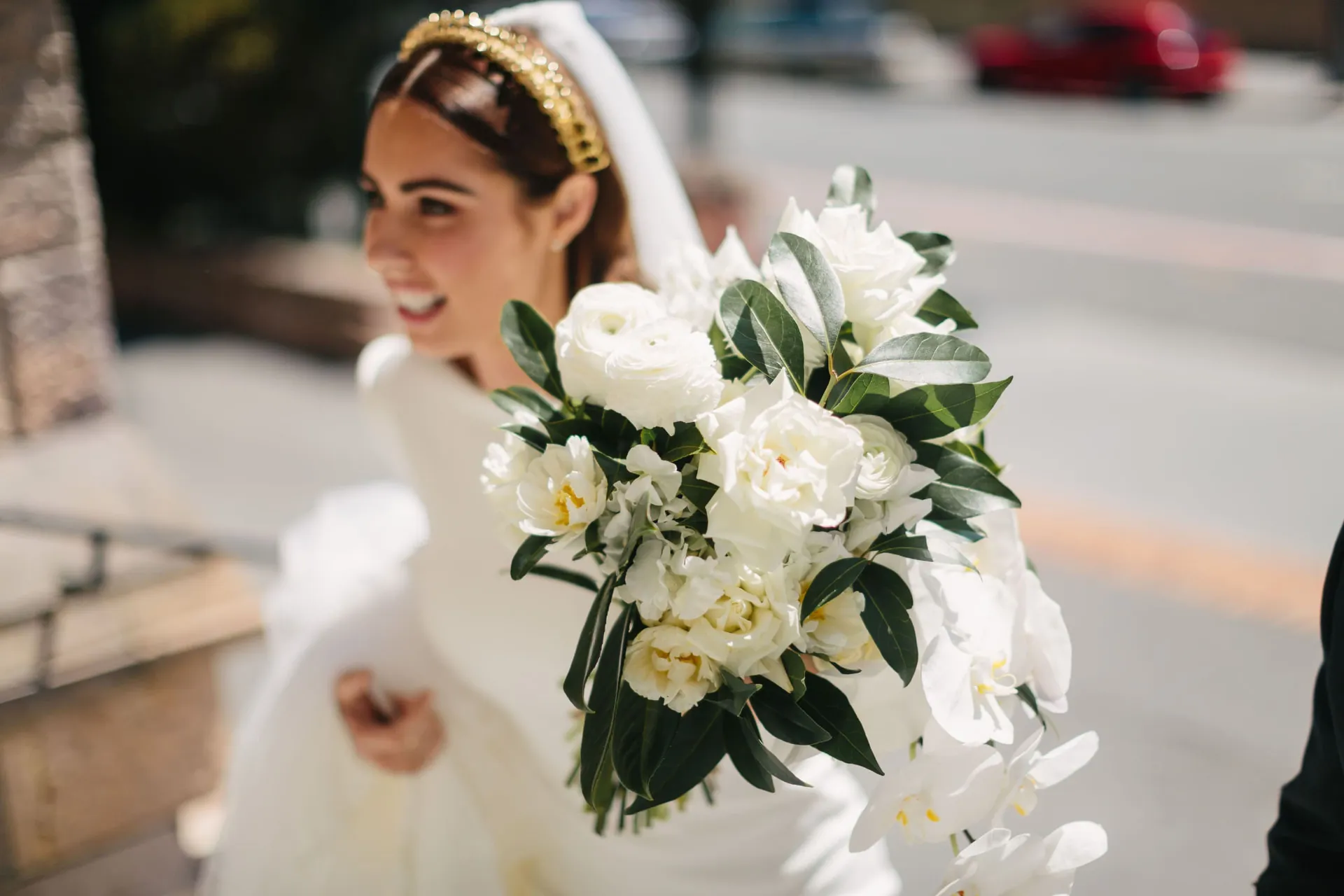
A bouquet is an architectural element in itself, when it comes to design and visual impact, even if it is physically small compared to the space or venue at which your event will take place.
Bridal bouquets are seen in many of the most photographed aspects of a wedding day. They accompany the bride throughout the ceremony, portraits, congratulatory photos, dinner and on occasion late into the night.
You would assume that creating such a beautiful arrangement was effortless; however, there is much planning and structural detail that goes into each arrangement.
A bouquet is going to have a certain "look" which includes such elements as shape, balance, rhythm and proportion.
The bouquet has to look great whether viewed straight on or at an angle.
A bouquet has to be able to be held comfortably while still being visually appealing in its own right and not competing with the dress for visual attention.
It should fit the person holding it as well as relate back into the overall floral design of the wedding. That balance begins with what I call the silhouette (or general form) of the bouquet.
When determining if our client wants a loose, asymmetrical bouquets or one that is tightly rounded; when deciding how much cascading will occur through use of orchids or foliage etc.; and/or when simply deciding whether we want our client's bouquet to be very full and abundant (and therefore probably a lot heavier), we first determine the general form of her bouquet (shape).
The style or design of the wedding bouquet will depend on many factors including the bride, her dress, as well as the general feeling or atmosphere of the wedding.
For example, if you have a very formal or structured gown for your wedding then a bouquet featuring strong lines and architectural shaped flowers would be perfect for this type of gown. On the other hand if you are wearing a soft flowing wedding gown then a more laid-back and natural looking bouquet would probably be best suited.
As I mentioned there is no set "rule" when creating a wedding bouquet. It should look like an extension of the person carrying it.
When selecting your wedding flowers consider both how tall you are and your body proportions as these things will greatly affect what size and colour combinations of flowers will look good in relation to your face.
Keep in mind that a bouquet may look absolutely beautiful sitting alone on a work bench but may completely fall apart once held by someone (this can especially occur if using heavy floral materials). As such, we always take steps back and view our bouquets from a distance similar to which they will be viewed through photographs at your wedding reception.
The bouquet mustn’t hide the dress or overwhelm the bride.
Instead it frames her and does not overtake her visually.
After determining our overall shape, we begin considering movement with the design of the bouquet.
Most beautiful bouquets do little to no standing still; there may be a single flower which extends slightly past the majority of the structure of the arrangement. There could be a curved stem extending outward from the centre of the arrangement. An orchid can hang loosely off to one side.
These random aspects add personality to your floral arrangement.
If an arrangement is perfectly symmetrical, lacking any movement, although well put together, it can appear stiff.
Nature allows flowers to grow in many directions. We also would like for some part of that natural growth to remain intact within each piece (bouquet).
Ideally, you want a bouquet that feels as if you designed it yourself but is not overly contrived by nature or man-made.
The focus point flowers will serve as focal points (anchors) visually.
Often they are the very first things we see when looking at a bunch of flowers. They could be large rose bushes or dahlia flowers, or peony flowers with an interesting shape.
Then there are smaller supporting flowers (or greenery) to give the bouquet additional texture and dimension.
The small blooms, the delicate leaves, the long slender stems all add up together to break-up those transitional areas in between each of the main focal points.
It is this balance of all of these floral elements that make a bouquet so complex for us as designers.
Colour will come last.
We usually approach design by thinking about our desired proportions and silhouettes before deciding on colour because if we do too much too early it will distract us from achieving what we want in terms of proportion.
After we like the way the bouquets silhouette works together we then look at how different shades of colours can work their way throughout the arrangement.
You could go for a monochromatic arrangement with many versions of one colour, or you could opt for a more dynamic combination using complementary shades.
There is an amazing range of possibilities even if you choose all white flowers; from warm ivory through to cool white, cream and pale green, right down to soft blush. A limited palette does allow for the possibility of creating depth in your floral arrangement without being overly reliant on colour.
Texture becomes very important when working within a limited palette like this.
Depending upon the time of year it is possible that your flower choices may also be influenced by what flowers are readily available locally during the months leading up to your wedding.
Working with seasonal flowers will give you a sense of generosity and connection to the particular month that your wedding takes place in.
But they can also provide some exciting opportunities.
Perhaps a couple begins with an idea for what kind of flower to use. Then there's one more variety that looks similar, however has an interesting texture or shape.
The flexibility in this case often makes the end result (the bouquets) much better.
It is very important both how something appears and how long it will last.
A wedding bouquet may have been handled, moved around, possibly even sat out in sunlight, etc., for hours before it reaches its destination.
There are many flowers that are far more delicate than other types of flowers. We take the time to properly care for every single stem we cut. We use construction techniques which will allow the bouquets to remain fresh through-out the day.
In addition, we want our brides to be able to hold their bouquets comfortably all day.
It's rare people think about how much a flower arrangement weighs until they are carrying the arrangement for a while.
A large floral arrangement can be quite heavy when combining all the stems and water to the flowers.
Building your arrangement well will help to evenly distribute this weight. Building a good, even balance in the bouquet so it feels like it has heft in the hand as well.
In addition, there is the handle of the bouquet.
Depending on what type of arrangements you build, sometimes they may have exposed stems; at times they may be completed with ribbons or some other materials added onto them.
Regardless of which option you choose, make sure that whatever finish you create looks intentionally done. Make sure the finish fits with the overall design concept.
However, regardless of how beautifully constructed your design is, and if it's beautiful in photographs as well (the bouquet will be shown in close-ups, full-body portraits, ceremony photos etc.), there will still need to be consideration given to how comfortable and secure your clients find their bouquets to hold.
In order to create a bouquet that will be able to provide enough details as you take a closer look at the arrangement, there still has to be an obvious silhouette or overall appearance when viewing from afar.
A good bouquet is easily recognisable, even if it is viewed from a wider angle.
Each bouquet will have its own distinct perspective.
But above all else, each bouquet needs to express how personal it is.
You do not want your wedding flowers to appear as though they were chosen from a catalog.
Wedding flowers should represent what kind of atmosphere was present during the celebration; the location where the wedding took place; which time of year it occurred; and who held those flowers.
It would be possible to choose exactly the same type of flowers for two completely different weddings, yet end up creating two very different bouquets.
This makes floral designing so exciting.
Beginning with the raw product (flowers), it is about how they are presented, proportionally, their movement or placement and structure as well as restraint. When all these elements come together, an arrangement for a bride feels completely effortless to hold.
In fact, an arrangement for a bride will feel like it fits perfectly into your hand, it pairs beautifully with her gown and adds to the overall visual memory of her wedding day. That is what I refer to as the "architecture" of a bouquet. In other words, the structure that provides the framework and support for the softness of the blooms; and careful decision-making on my part to create something that looks entirely natural.